

It's time to stop treating brands like abstract concepts
From memorable to meaningful: Why creating brands with meaning matters for businesses in a cynical world
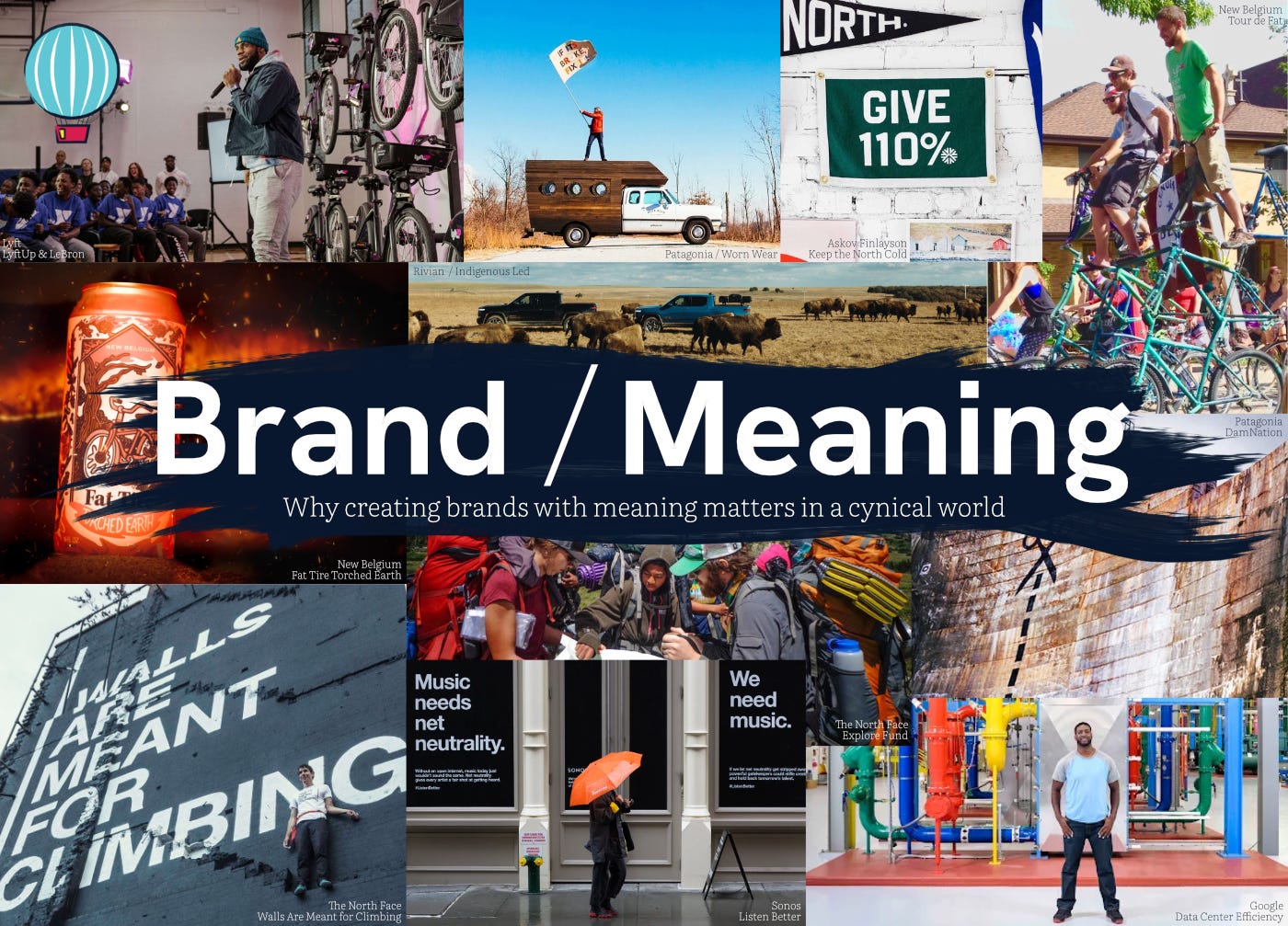
The other day, while watching Big Future’s hometown Minnesota Timberwolves take on the Golden State Warriors in the NBA Playoffs, I found myself staring back at a snappy commercial featuring the story of a man named Drew who beat cancer.
I immediately predicted the ad was for MD Anderson Cancer Center, or maybe Sloan Kettering. Or it could be a health insurer like UnitedHealthcare (another hometown brand, albeit less beloved than the Wolves).
Turns out, it was a spot for United Airlines, and it went on to show Drew taking a celebratory flight to “somewhere tropical” during which the pilot – inspired by the man’s story – makes a personal announcement over the intercom before showering him with free drinks, donuts, and handwritten cards. (I guess pilots aren’t bound by HIPAA.)
Now, I’ve flown United countless times and not once have I heard a pilot celebrate a cancer survivor, let alone seen a fresh donut served anywhere near a United cabin. And I’m willing to bet you haven’t, either.
Which makes this ad utterly meaningless. The story reads false because it doesn’t match the public’s own brand experiences. It reads weak because we assume United deliberately chose cancer as the least controversial issue imaginable. It reads avaricious because celebrating one customer one time doesn’t cost the company anything. And it reads vapid because there’s zero link between cancer and United’s business model or brand identity.
The spot concluded with a tagline – “Good leads the way” – which confused me further upon discovering that United’s eponymous web page offers a sales pitch, not commitments to support cancer research or treatment or any other “public good” for that matter.
Clearly, United sees value in trying to promote itself as a “good” company. But in today’s fractured and cynical society, making the safest possible choice is actually becoming dangerous.
Being memorable isn’t enough in a cynical world rife with copycats
United appears to be hoping a cute, cleverly-edited story about a customer getting nice treatment by an airline employee will stick in our memories.
This might have worked in the past. In an era of historic cynicism that permeates our culture and politics, I’d argue an ad like that is only memorable for the wrong reasons. These days, only 34 percent of Americans (just 25 percent of those ages 18-29) think capitalism is working for regular people. Turning to U.S. politics, our trust goes from woeful to abysmal.
Then there’s the proliferation of cheap copycats or dupes. During inflationary times, brands that lack a protective moat filled with meaning find themselves far more vulnerable to getting raided by a growing army of knockoffs. Just one point of reference – in 2023, the World Intellectual Property Organization saw a record number of domain name disputes, up sharply from the year prior, and a 68% increase compared to pre-COVID levels.
Consumers are buying it – loving it, even. Dupe culture is a whole thing. More than 70 percent of Gen Z, and almost as many Millennials, report they sometimes or often buy dupes. Desperate for meaning, and they’re finding it in dupe culture itself as too many brands leave them wanting. And, while it’s possible tariffs could cut down on cheap copycats, the still-unfolding impacts of Trump’s trade policies will further complicate and erode traditional brand loyalty, increasing the pressure on brands to stand apart from those around them.
What does brand meaning…mean?
In the past, the most successful brands were often the most memorable. Advertisers sought to be top of mind at the point of purchase. We’d buy a brand because it made us laugh, or aligned with a celebrity we liked, or caused us to feel cool, or wealthy, or nostalgic, or smart. It was all very abstract, and often brands lived in a vacuum totally disconnected from the real world.
Many brands still rely on this thinking at their own peril. United Airlines wants us to believe it’s a “good” company, one that cares about its customers. Why? Because United’s customer satisfaction scores have slipped to the worst among major U.S. airlines except for (ahem) Spirit and Frontier, and J.D. Power ranked United last in customer satisfaction among traditional U.S. carriers. Being “good” is an abstraction at best, especially when not backed by action.
Data clearly shows that consumers and other stakeholder groups – namely employees – want to support brands that connect meaningfully with culture and community.
In other words, today more than ever, we want our brands to mean something, a distinction that’s earned through clear values, a worldview resonant in the public consciousness, and tangible actions to pursue it – all rooted in your core business.
Brand meaning builds community builds thriving companies
Establishing shared identity with audiences through views and values grounded in action has never been more important to a company’s bottom line. Eighty-four percent of consumers say they need to share values with a brand to use it. And nearly two-thirds of Gen Z feel more connected to people who use the same brands as they do.
Mainstream Americans want business to get in on the public good
While fringe voices at the far ends of our political spectrum get all the attention, the vast middle shares a very simple expectation: More than 90 percent of Americans think companies have a responsibility to promote an economy that serves everyone. But very few think companies are doing this well.
The best talent goes where the meaning is deepest
While reputational value can be hard to measure, the financial upside of recruiting and retaining top talent (and avoiding costly turnover) is far easier to grasp. Nearly 80 percent of U.S. workers want to work for a company that shares their values – and backs it up with action. And 35 percent have already quit a job because their employer didn’t stack up.
We respect what’s well-defined, not watered down – even if we disagree
Instead of reaching for the lowest common denominator, remember that 77 percent of Americans respect companies more if they’re clear on their values – even if they don’t agree. In fact, both Patagonia and Chick-fil-A – brands famous for their unflappable but polar opposite commitments to values-driven decisions – rank in the top five brands with the best reputations nationally.
In an era of total transparency, advocacy builds trust
Finally, responsible business practices like fair treatment of workers and sustainable production aren’t enough on their own. Eighty percent of Gen Z believe companies should advocate on social issues relevant to their business and/or its community. Most assume a brand is hiding something if it doesn’t.
What does brand meaning look like?
At the most basic level, a brand with deep meaning for its audiences lives actively at the nexus between the brand (and its business) and the cultural conversation – or at least the portion of the cultural discourse most relevant to that brand’s own community.
Brand meaning will look vastly different for each individual brand. The smartest brand will chart a strategic path to deeper meaning that presents a perfect fit for the core business, unique brand positioning, and the real-world needs of its community. A brand packed with authentic meaning for its audiences will stand out in a sea of copycats, legit competitors, established players – without getting singled out.
While not every brand must incorporate a push for systemic change into their strategy, evidence and experience tells that the most meaningful brands adopt platforms that show a tangible commitment to getting outside the brand bubble and working for the betterment of their community. In an era of total transparency, there’s no disconnect between a company and its brand, or hiding behind a creative abstraction. The most meaningful brands lean into real-world business practices to build meaning, while behaving as human as the people behind them.
Here are a few of our favorite examples of highly meaningful brands:
Community meaning: LEGO – mobilizing kids’ creativity
The blockmaker LEGO has always been a unique company. It’s 25 percent owned by its philanthropic arm, committed early to becoming net-zero by 2050, advocates for kids’ wellbeing in a digital world, and has a strong record of building diverse representation into its characters and sets. In 2010, the brand launched Build the Change to mobilize kids (and their teachers) to imagine (and build) creative solutions to real-world challenges like climate change and inequality.
A social impact program tied perfectly to LEGO’s business model, product, and ethos – plus built for high cultural relevance, humor quotient, and social shareability – Build the Change consists of a set of open-source programs and resources that enable any organization, teacher, or parent to get kids involved in designing the future they want to live in. Actual ideas include an anti-cow-farting machine to Funkadelic Batman’s flying turtle nest protector and millions more.
BUSINESS RESULTS: The number of kids participating in Build the Change – reaching 2 million in 2023 – has surged as LEGO ranked as the #1 most reputable company in the world for the second year in a row. And it’s not just kids that get involved – LEGO is creating meaning, trust, and brand love among parents and teachers with serious buying power, too. The company enjoyed record top- and bottom-line growth in 2024, boosting revenues by 14 percent and sales by 13 percent.
Cultural meaning: Voodoo Ranger – not your father-in-law’s IPA
One of the highlights of my career was working on New Belgium Brewing’s category-busting IPA brand, Voodoo Ranger. In addition to turning out innovative, high-ABV flavor-bombs in 24-ounce cans, Voodoo Ranger created brand magic by using an illustrated character – irreverent, dry, and definitely not a craft beer snob – as spokes-skeleton. Destroying the conventional craft beer playbook, our team built a loyal base among gamers, sponsoring Twitch streamers, showing up at Comic Con with a life-size pirate ship, and turning sarcasm into an art on Instagram.
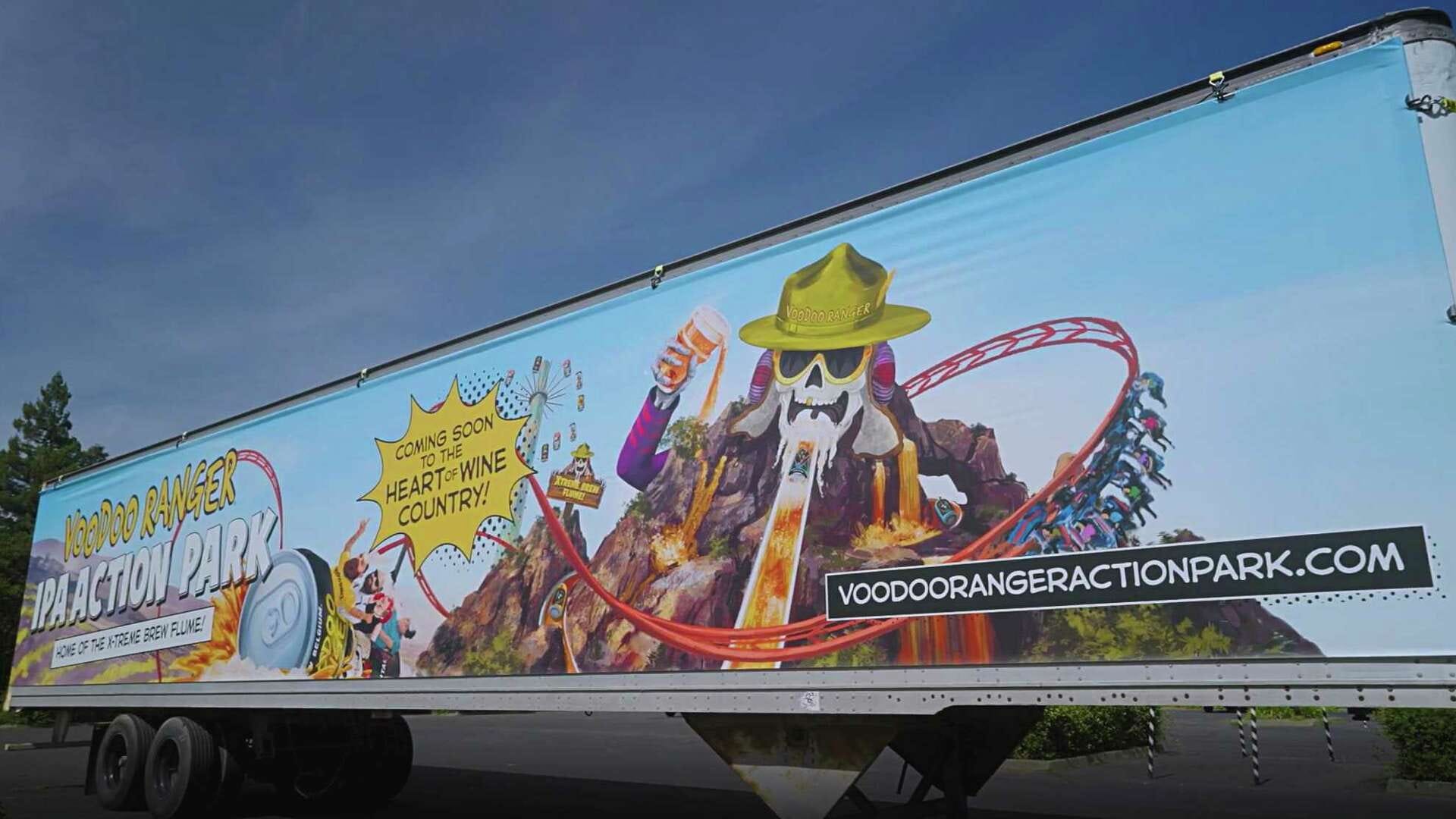
In 2022, with the goal of expanding the brand’s reach beyond craft beer enthusiasts, we placed a 53-foot billboard in the heart of Napa wine country – a global symbol of elitism – promoting a Voodoo Ranger beer-themed “action park,” complete with a 130,000-gallon wave pool filled with IPA. A mortally offended local community rallied angrily for protests, community meetings, and letters to the editor before our prank was revealed – while beer drinkers everywhere celebrated the brand’s epic rejection of snobbish craft beer culture once and for all.
BUSINESS RESULTS: The stunt buffeted the brand’s back-to-back #1 craft beer launches in U.S. history, helping to nearly triple Voodoo Ranger brand family sales over just three years, and driving strong growth for New Belgium at a time when competitors were crashing hard.
Advocacy meaning: e.l.f. beauty – putting the diabolical in DEI
At a time when Asian beauty brands were stealing U.S. market share at a rapid clip, e.l.f. beauty went in search of ways to inject meaning into its brand. It considered its own audience (mostly women), its core value of inclusivity, its fun and youthful brand positioning, and a key insight: e.l.f. is one of just four publicly traded U.S. companies with a board of directors made up of two-thirds women and one-third diverse, while diverse women on public boards were outnumbered by men named Richard, Rick, or Dick. The outcome: a cheeky but substantive campaign the brand calls “So Many Dicks,” designed to call attention to this sad state of affairs and help change it.
e.l.f. launched an ad campaign calling attention to the situation and invited companies to start conversations about how board diversity can drive business success. It also launched a partnership with the National Association of Corporate Directors, sponsored 20 women and/or diverse board candidates, and partnered with feminist icon Billie Jean King.
BUSINESS RESULTS: Since “So Many Dicks” launched in early 2023, e.l.f.’s has become a poster child for how to build brand meaning and shared identity with consumers through action – especially at a time when companies shrink away from DEI. And the campaign has coincided with a 40 percent increase in net sales in the last nine months of 2024 compared to the same period in 2023.
Collective meaning: Riot Games – inviting gamers to give
You might have seen Riot in the news following the L.A. wildfires. The company, which is based in Santa Monica and makes top video games like League of Legends and Valorant, donated a generator to a nearby fire station, donated hundreds of meals from its employee cafeteria, and created in-game fundraisers to empower gamers to join the effort.
What you might only know if you play Riot games? The brand has mobilized gamers to raise more than $50 million in recent years to fund donations to more than 450 groups worldwide. And the Riot Games Social Impact Fund is not your typical corporate impact initiative – off to the side, not too visible, controlled by a few folks at HQ. Instead, it’s embedded deep into top video games, with custom skins and other buyable assets designed specifically for each game, with the goal of inviting gamers to participate by making small donations (that add up). Riot then goes a step further by giving gamers the opportunity to help select funding recipients – often local nonprofits working directly for the benefit of Riot’s extended community on issues like education, economic opportunity, citizenship, and sustainability. Last fall, the brand doubled down by donating all the proceeds from certain League of Legends skins – plus a company-funded triple match – to celebrate the game’s 15th anniversary.
BUSINESS RESULTS: Riot has faced serious issues in the past around plus in-game toxicity and workplace gender discrimination and sexual harassment. But it also clearly believes that its mission to “create the most player-focused games in the world” includes sparking collective action to support positive change. Players are responding: In 2023, nearly 600,000 participated in voting for nonprofit recipients through Riot’s impact fund; and, while women typically make up 7 percent or less for similar games, the Valorant community includes 30-40 percent women – driven by Riot programs like Valorant Game Changers, an esports competition specifically for women and other marginalized players named a World Changing Idea by Fast Company.
Meaning is a moat
Brand meaning matters for business. In fact, a recent study shows why – in an age of information fragmentation – your ability to connect with target audiences may depend on it. A recent study shows 51 percent of American consumers say it’s important they feel like part of a brand’s community, and even more say they’re likely to try a brand recommended by their community.
Embracing a strategy to create a more meaningful brand – especially with a firm advocacy agenda – represents a cost-effective path to tangible results. These include:
Building deeper customer relationships that last
Boosting employee engagement and recruitment power
Sparking breakthrough media attention and organic reach
Generating new leads, especially among would-be Gen Z brand advocates
Strengthening reputational fortitude and resilience in the face of crisis
Creating potent influence and impact in the public square
You can think of a meaningful brand as a means to achieve the stuff marketers (and HR leaders) dream of. Or you can think of it as a moat to protect against cynicism, competition, and copycats. Either way, it’s critical to business success today – and tomorrow.
Ok, but how do brands create meaning?
We can’t say it enough – every brand is unique, and needs to develop meaning authentically, transparently, and in line with its unique business model, brand, and community. It requires a willingness to go beyond brand positioning (and even purpose) and build a strategy grounded in your business, with consistent actions to reinforce a worldview that matters to your community.
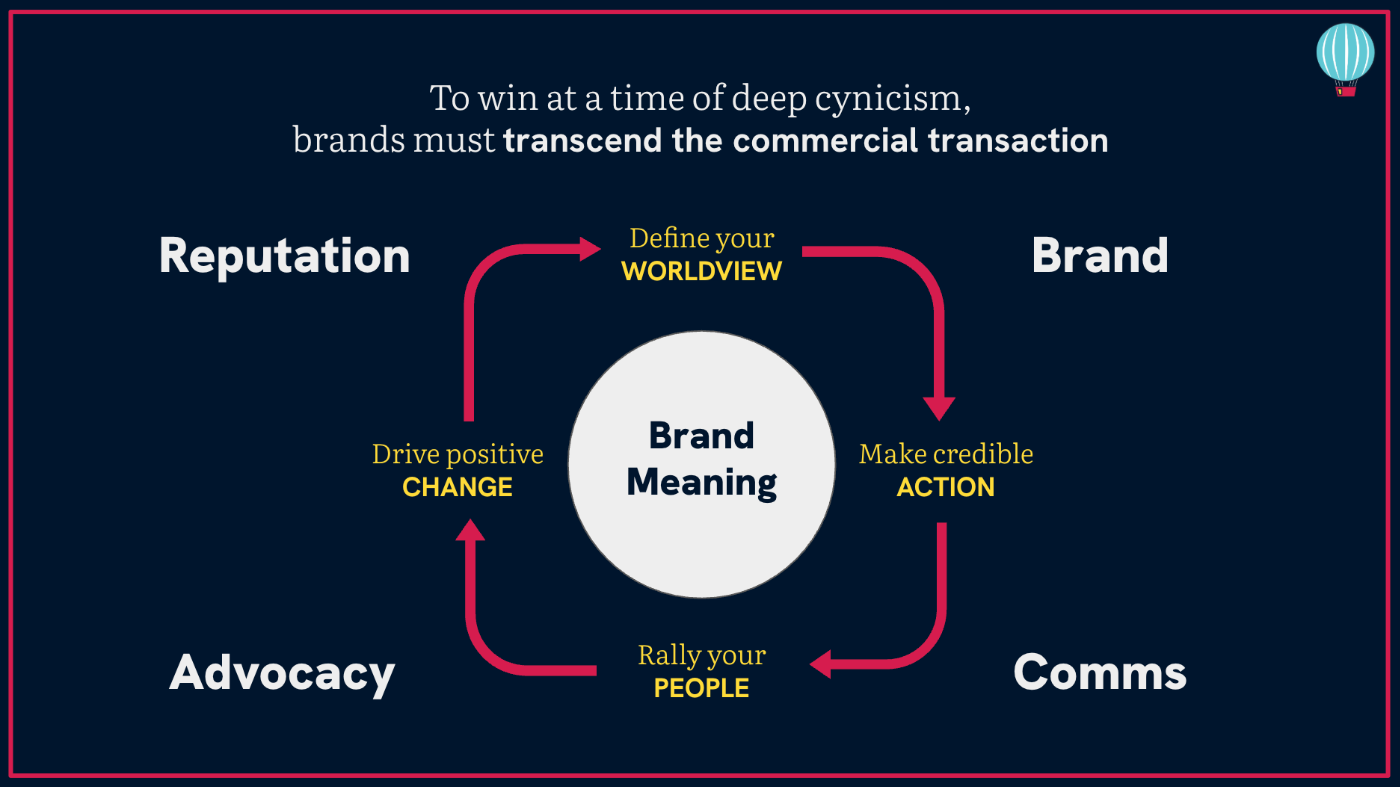
It’s not difficult to get started – and any brand can begin this work with a low cost of entry. At Big Future, we utilize four deceptively simple steps to building modern brand meaning to guide nearly every project we undertake:
Define your worldview
Develop a cohesive narrative that encompasses the spot where your brand connects with culture and society. This phase is about escaping the vacuum and gaining a secure foothold in the discourse, and it requires a nuanced grasp of the contextual landscape in which your brand exists, a deep understanding of your community and their needs, and a clear sense for how you can help meet them.
Make credible action
Do things in the real world to earn relevance with key audiences and reinforce your worldview. Action isn’t an ad campaign – it’s a willingness to show up for your community and prove you’re on their side. The best brands shatter the inherent assumption it's all about profit-making by doing real things that run counter to conventional business.
Rally your people
Brands become so much more meaningful when they form relationships with consumers (and employees) that transcend the commercial transaction. If you relate to your customers only by selling, they will not be as eager to buy. This phase is about inviting your community to join you in pursuing a common worldview – and, ideally, making it fun, inspiring, and worthy of their time and attention.
Drive positive change
The greatest echelon of brand meaning belongs to brands that advocate for change in focused, consistent, and business-aligned ways. The goal here is to carve a territory for advocacy that is unimpeachably connected to your business, brand, and community – so it becomes that much harder for a vocal minority of detractors to try and tear your brand down. Do this right, and your community will fight back for you when they try.
No time to waste
Ever since Donald Trump was elected for a second time in November, I’ve heard a lot of people in business assert that Americans no longer want businesses to be involved in politics.
While it’s true that consumers find broad resistance to Trump or any political figure or ideology distasteful, Americans do want the brands they support to make meaningful contributions to the public good. They expect those contributions to fit the nature of the business and the needs of their communities. They want to see consistent actions toward a clear agenda – not flailing around in response to the latest flashpoint.
We’re all sick of feeling cynical and distrusting. The most successful brands of the future will be those that prove they’re worthy of our trust – that stand with people who rightfully believe the deck is stacked against them. As every brand with an eye to the future works to reach young people, 53 percent of Gen Z would prefer to buy from a brand that intentionally cultivates a distinctive community over one that tries to appeal to everyone.
In other words, we want the brands we buy to mean something. Of course, this work doesn’t happen overnight – it takes thoughtful planning and builds over time. In the time brands spend waiting for a better time, they might find themselves hopelessly meaningless – eclipsed by competitors or disruptors that understand the days of fronting gauzy “purpose” statements or just creating “good” vibes are over. The moment to break the brand bubble – for brands to engage in the world meaningfully through actions and advocacy – is here to stay.